


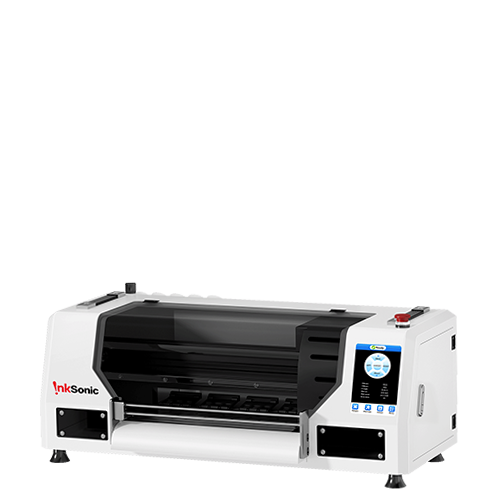





For many home-based and small custom T-shirt businesses, a 13-inch A3/A3+ DTF printer offers the best balance of print size, equipment cost, and production capacity. The right DTF printer for shirts depends mainly on order volume: an L1800-based system can suit lower-volume work, F1080 is a stronger fit for regular shirt orders, and a dual-head XP600 makes more sense when throughput becomes the priority.
Our picks are InkSonic C13B for value-focused users, H13 for the best balance of ease of use and performance, and U13D for higher-volume production. Manufacturer-listed output is useful for comparison, but production varies with artwork, layout, curing, workflow, and operator speed.

Best DTF Printers for Shirts at a Glance
Model |
Printhead |
Maximum Print Width |
Manufacturer-Listed A3 Speed |
Approx. Manufacturer-Listed Shirt Output |
Best For |
InkSonic C13B |
L1800 |
13" |
5-8 min |
Approx. 8 shirts/hr |
Value-focused users |
InkSonic H13 |
F1080 |
14" |
2-4 min |
Approx. 12 shirts/hr |
Beginners and growing businesses |
InkSonic U13D |
Dual XP600 |
13" |
2-4 min |
Approx. 20 shirts/hr |
Higher-volume production |
The C13B keeps the initial investment lower while providing a practical 13-inch print width for shirt production. The H13 moves to the F1080 platform with a wider 14-inch format and a focus on easier operation and maintenance, making it a strong choice for beginners and growing shops. The U13D costs more because its dual XP600 printhead design is built around throughput: its main advantage is producing more transfers in a production window, not making an individual transfer automatically look better.
In practical terms, C13B favors value, H13 balances usability and performance, and U13D favors batch capacity. Compare them against your normal weekly order volume, not your busiest possible day. Prices shown are current at publication time and may change. Speed and shirt output are manufacturer-listed figures, not independent benchmark results.
What Should You Look for in a DTF Printer for Shirts?
Print Width: Why 13-Inch/A3+ Works for Most Shirts
Print width determines the artwork size you can place on film without splitting a design. An A4 DTF printer is compact and works for small logos, left-chest graphics, sleeves, kids' shirts, and other smaller transfers, but larger front or back graphics can exceed its usable area.
For many small apparel businesses, a 13 inch DTF printer is the practical middle ground. An A3 DTF printer or A3+ DTF printer provides room for common adult T-shirt graphics and multiple smaller designs on PET film while still fitting a home studio or small production room.
Wider 17- to 24-inch systems make more sense when roll production, large gang sheets, and sustained commercial volume outweigh desktop convenience. For a growing DTF printer for t shirt printing, 13 inches usually covers the artwork sizes most shirt customers expect without moving into a much larger production footprint.
Printhead and Throughput
The printhead affects practical print speed, but the right choice should follow order flow. An L1800 DTF printer generally costs less and suits modest production. InkSonic lists the C13B at about 5-8 minutes for an A3 print and roughly eight shirts per hour.
An F1080 DTF printer is a stronger fit when orders arrive consistently. InkSonic lists the H13 at about 2-4 minutes per A3 print and roughly 12 shirts per hour, which reduces waiting when several jobs run in one session.
A dual head DTF printer such as the U13D is aimed at batch production. InkSonic lists 2-4 minutes for A3 and about 20 shirts per hour. The higher purchase price makes sense only when you can use that capacity.
Choose a printhead for production demand; the fastest machine is not automatically the best purchase or the source of better print quality.
White Ink Management and Maintenance
White ink is a key maintenance issue in any DTF shirt printer because its pigment can settle. White ink circulation keeps ink moving, while mixing and filtration support more consistent ink flow. These systems can reduce conditions that contribute to nozzle clogging, but they do not make a printer maintenance-free.
Before buying, ask how often the machine needs a nozzle check, what cleaning is automated, how easy the printhead and capping area are to access, and whether replacement parts are available. Check the warranty and technical support as well.
For real shirt production, predictable maintenance can matter more than chasing the highest advertised DPI. A direct to film printer for shirts should have a routine you can realistically follow. A faster machine provides little benefit if preventable maintenance problems repeatedly stop paid production.
Workflow and Automation
A T-shirt DTF printer is one part of the production line. You also need RIP software to prepare artwork and the white layer, DTF ink, PET film, adhesive powder, a curing oven or another approved curing solution, and a heat press to apply the transfer.
As volume grows, automation can remove repetitive labor. A DTF printer with oven setup works for lower-volume production when you can powder transfers manually and cure them in batches. A DTF printer with powder shaker becomes more useful when repeated manual powdering slows production; an integrated dryer can cure film as it moves through the workflow.
The goal is a balanced line. Higher print speed will not raise finished shirt output per hour if powdering, curing, or pressing becomes the new bottleneck. Match printer capacity to the rest of the workflow rather than evaluating the printer by itself.
Which InkSonic DTF Printer Is Best for Your Shirt Volume?
InkSonic C13B - Best Value for Entry-Level Shirt Printing
The InkSonic C13B is a practical choice for users who want A3+ shirt-printing capability while keeping the initial equipment investment lower. It uses an L1800 printhead, provides a 13-inch print width, and is designed for creators, small shops, and users building their first DTF workflow.
If you currently produce around 5–10 shirts per day, the C13B can handle personalized orders and short runs without requiring extra production capacity. With an A3 print time of around 5–8 minutes, it is a good fit for custom apparel projects where keeping equipment costs low matters more than maximum speed.
Choose C13B when your order volume is still developing and you want a reliable entry-level DTF setup without paying for capacity you do not need yet.
InkSonic H13 - Best Balance of Ease of Use and Performance
The InkSonic H13 is designed for users who need a faster and smoother daily printing workflow. It uses an F1080 printhead, offers a wider 14-inch print width, and combines higher efficiency with easier maintenance features.
For shops producing around 10–25 shirts per day, the H13 provides more room for growth. With an A3 print time of approximately 2–4 minutes, printing 10 designs could take about 20–40 minutes, helping reduce waiting time compared with slower entry-level systems.
Choose H13 if you want a balance of speed, convenience, and long-term usability for home businesses and growing apparel shops.
InkSonic U13D - Best When Throughput Matters
The InkSonic U13D is designed for businesses where production speed becomes a limiting factor. It uses dual XP600 printheads and delivers approximately up to 20 shirts per hour.
If you regularly handle 30+ shirts per day, the U13D can better support batch orders by keeping more jobs moving through the printer. The dual-head design is most valuable when order volume is high enough to fully use the additional production capacity.
Choose U13D when throughput, batch production, and reducing production bottlenecks are more important than the lowest upfront cost.
Quick decision:
Choose C13B if you produce around 5–10 shirts/day and want an affordable starting point.
Choose H13 if you produce around 10–25 shirts/day and want the best balance of performance and ease of use.
Choose U13D if you handle 30+ shirts/day and need higher production capacity.
What Equipment Do You Need to Print DTF Shirts?
A DTF printer does not produce finished shirts by itself. You also need adhesive powder, curing equipment, a heat press, RIP software, DTF ink, PET film, and basic cleaning supplies.
For lower-volume production, a practical workflow is:
Printer → PET film → Manual powdering → Curing oven → Heat press
This setup keeps equipment investment lower and works well when transfer volume is manageable by hand.
For higher-volume production, the workflow can become:
Printer → Automatic powder shaker/dryer → Heat press
A powder shaker and dryer become more useful when batch orders grow and manual powdering or curing starts to slow production.
For a small shop, start with the simplest workflow that matches your current orders and add automation only when it removes a real bottleneck. A faster printer will not increase finished-shirt output if powdering, curing, or heat pressing cannot keep pace. Your actual production speed is determined by the slowest stage in the workflow.

What Shirts Can You Print With a DTF Printer?
A DTF printer for T-shirts is useful because it is not limited to one common shirt fiber or only light-colored garments. With the correct film, ink, powder, curing, and press settings, DTF transfers are commonly used on cotton, polyester, and cotton-poly blends. They can also be applied to both light and dark shirts because the printed white layer creates an opaque base beneath the color artwork.
That flexibility makes DTF useful for shops that receive mixed orders. You may print a cotton event tee in one job, a polyester performance shirt in the next, and a blended work shirt after that without changing to a completely different decoration method. Hoodies and sweatshirts can also fit the same general workflow when the garment and press setup are appropriate.
Compatibility is broad, not unlimited. Specialty coatings, highly heat-sensitive fabrics, unusual textures, and seams can affect transfer results. Test unfamiliar garments before selling them, and adjust heat press temperature, pressure, and time according to the film, powder, ink, and garment requirements. Good wash durability depends on the whole process, not fabric compatibility alone.
How Much Does a DTF Shirt Printing Setup Cost?
Cost Item |
What to Budget For |
Estimated Cost (USD) |
DTF printer |
Main equipment investment |
$2,299–$4,799 |
Curing solution |
Oven or shaker/dryer |
$300–$2,000 (basic curing oven to integrated shaker dryer systems) |
Heat press |
Final garment transfer |
$300–$1,500 |
RIP software |
Check whether included or separate |
$0–$1,000+ (depending on whether included or purchased separately) |
Initial consumables |
Ink, PET film, powder |
$100–$500 |
Ongoing consumables |
Ink, film, powder per production volume |
$50–$300+ per month (depending on order volume) |
Maintenance / support |
Cleaning fluid, dampers, printhead-related parts, warranty and service |
$100–$500+ per year |
Printer price is not the same as startup cost. In the current InkSonic comparison used here, the C13B, H13, and U13D prices vary by configuration and promotion at publication time, but those prices can change. Your usable setup also needs curing and pressing equipment plus consumables.
Total cost of ownership matters more than the checkout price. Budget for DTF ink, PET film, adhesive powder, cleaning fluid, dampers and other maintenance parts, possible printhead-related expense, software if it is not included, and replacement components. Labor and downtime also have a cost. A cheaper printer that repeatedly stops paid production can become more expensive than a higher-priced machine that better matches your workload.
Workspace is another real cost. A printer, curing oven, heat press, film handling area, storage, and ventilation all need room. A shaker/dryer increases the footprint further, even when it saves labor.
If you only print occasional shirts, ordering ready-made DTF transfers may still be financially easier because printer ownership creates ongoing cleaning and maintenance obligations. Once orders become consistent, producing transfers in-house can give you more control over turnaround, scheduling, and small-run customization. Use your actual order history rather than an optimistic sales forecast when deciding whether the equipment investment is justified.
Before comparing bundles, list what is actually included. A printer package may include starter ink, film, powder, RIP software, or a small press, while another price may cover only the printer. Comparing sticker prices without normalizing the included equipment can make the cheaper option look better than it really is.
FAQs About DTF Printers for Shirts
Can I use a DTF printer for T-shirts?
Yes. A DTF printer for shirts can produce full-color transfers for cotton, polyester, cotton-poly blends, and both light and dark shirts when the correct PET film, DTF ink, adhesive powder, curing, and heat press process is used. The white underbase is what allows color artwork to remain visible on dark garments.
What size DTF printer is best for shirts?
For many T-shirt businesses, a 13-inch A3/A3+ printer offers a strong balance between desktop footprint and enough print width for larger chest and back designs. An A4 DTF printer can work for smaller graphics, while wider machines become more useful as production scales. Choose based on the largest artwork you sell regularly, not occasional oversized requests.
What is the best DTF printer for beginners?
There is no single beginner model for every buyer. Match the printer to your budget, expected order volume, available workspace, maintenance comfort, and required print size. A lower-cost L1800 system can suit modest volume, while an XP600 can be easier to justify when regular orders make speed more important. Also consider support, replacement-part availability, and how much routine cleaning the machine requires.
Does DTF come off shirts in the wash?
Properly produced transfers can have strong wash durability, but there is no universal wash-count guarantee. Results depend on curing, powder application, ink and film compatibility, heat press temperature, pressure, and garment care. Test a new material combination before customer production, and follow the transfer system's washing instructions instead of assuming every shirt and film combination behaves the same way.
Can DTF print on cotton and polyester shirts?
Yes. DTF is commonly used on cotton, polyester, and blended shirts. Specialty or heat-sensitive fabrics should still be tested with appropriate pressing settings before production. Fabric coatings, texture, seams, and heat tolerance can affect adhesion and the finished surface.
Is DTF or sublimation better for shirts?
DTF offers broader fabric and garment-color compatibility because it can use a white underbase, making it practical for cotton, blends, polyester, and dark shirts. Sublimation is particularly well suited to light-colored polyester substrates and avoids the DTF powder workflow. Choose based on the garments you actually sell rather than treating either process as universally better.


