


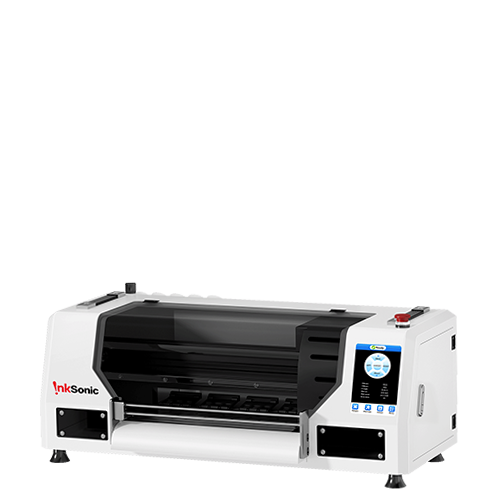


If you are searching for a press machine for t-shirt printing, you are usually looking for a heat press rather than the printer itself. The printer creates the artwork or transfer; the press uses controlled heat and pressure to bond that transfer to the garment. A typical DTF workflow is: DTF printer → transfer → heat press → T-shirt.
For most home businesses and small shops, a 15x15 heat press is a practical starting point. Move to a 16x20 heat press when oversized graphics, hoodies, or larger garments are a regular part of your orders.
Clamshell vs Swing-Away Heat Press: Which Design Is Better?
Frame design mainly affects loading, alignment, and workspace. A clamshell opens on a rear hinge, while a swing-away moves the heated upper platen completely away from the loading area. The better choice depends less on print quality than on how you work around the press.
Clamshell Heat Press
A clamshell heat press suits beginners, home businesses, and shops that mostly press standard shirts. Its compact footprint is easy to fit on a bench, loading is quick, and comparable models are often less expensive than swing-away presses. For a T-shirt printing business handling repeated front and back prints, that simple workflow is often enough.
The main compromise is access. Because the heated platen remains above the garment when open, thick hoodies, raised seams, and precise placement can feel tighter. With a manual heat press, the operator also has more responsibility for closing the press consistently, so setup and technique affect repeatability.
Swing-Away Heat Press
A swing away heat press moves the hot upper platen out of the way, leaving the lower platen fully exposed. That makes it easier to straighten a garment, align a transfer, and work around thicker items. It is a good fit when positioning matters more than keeping the machine as compact as possible.
The trade-off is floor or bench space because the head needs room to swing. In a tight production area, that extra movement can also slow loading. Choose a clamshell for a compact, quick shirt workflow; choose swing-away when platen access and positioning are more important.
What Size Heat Press Is Best for T-Shirts?
Platen Size |
Best For |
Main Limitation |
9×12 / 12×10 |
Small logos, kidswear, hobby work |
Limited adult-shirt coverage |
15×15 |
Most adult T-shirts, DTF, HTV |
Less room for oversized designs |
16×20 |
Hoodies, jerseys, large front/back graphics |
More space and cost |
16×24+ |
High-volume or oversized production |
Usually unnecessary for beginners |
If you are comparing heat press size for t-shirts, 15×15 inches is the practical middle ground for most small shops. It handles most standard adult graphics without taking over the workspace and leaves enough room to position a garment comfortably. For many new businesses, a 15x15 heat press offers the best balance of usable area, cost, and footprint.
A 16x20 heat press is more useful when large back prints, jerseys, hoodies, or oversized graphics are normal orders rather than occasional exceptions. The extra platen area reduces repositioning and gives you more margin around the artwork. A large heat press for t-shirts is worth the extra space when your usual transfer size regularly exceeds a 15×15 platen.
A small heat press machine still makes sense for sleeve logos, kidswear, sampling, or mobile work. It is easier to outgrow when standard adult shirts become the main product. The best size heat press for t-shirts is the smallest platen that comfortably fits the designs you produce most often, with enough room to load the garment without fighting the edges.
Manual vs Automatic Heat Press: Which Fits Your Production Volume?
Production Level |
Better Fit |
Occasional shirts |
Manual |
Home side hustle |
Manual / auto-open |
Regular daily orders |
Auto-open / automatic |
High-volume production |
Pneumatic / dual-station |
Manual Heat Press
A manual heat press keeps the setup simple and usually lowers the entry cost. It can still produce professional transfers when time, temperature, and pressure are set correctly, so low or moderate production volume does not require automation. A dependable t-shirt press machine with even heat is more useful than a feature-heavy model that cannot hold consistent conditions across the platen.
Auto-Open and Automatic Heat Presses
An auto-open heat press releases the upper platen automatically when the timer ends, reducing the risk of leaving a garment under heat too long. It does not necessarily automate closing or pressure; those functions depend on the press design.
Auto-open is especially helpful when one operator is also trimming transfers, loading shirts, or packing orders between cycles. A slide-out heat press improves access in a different way by moving the loading area away from the hot upper platen. A slide-out drawer can make garment placement safer and easier, but neither feature fixes uneven heat or poor pressure.
Pneumatic and Dual-Station Heat Presses
A pneumatic heat press uses compressed air to close the platen with repeatable force, reducing operator effort during long runs. A dual station heat press adds a second loading position so one garment can be prepared while another is pressing. These systems become useful when pressing itself limits throughput.
Automation does not automatically improve print quality. If heat distribution is uneven or the transfer is misaligned, the machine simply repeats the problem more efficiently. Higher-output presses earn their cost when production volume is high enough to benefit from faster loading, stronger pressure consistency, and less repetitive work.
What Makes a Good T-Shirt Heat Press?
Feature |
Why It Matters |
Even platen heat |
Prevents uneven or incomplete transfers |
Even pressure |
Critical for transfer adhesion |
Accurate temperature |
Reduces under-pressing and overheating |
Adjustable pressure |
Different transfers need different pressure |
Timer / auto-open |
Improves repeatability |
Platen size |
Limits maximum design size |
Slide-out lower platen |
Helps loading and positioning |
Build quality |
Matters under repeated cycles |
Warranty / support |
Important when downtime affects orders |
Start with the platen, not the control panel. A good machine should hold stable temperature across the full working area, not only at the center. Accurate temperature control and even heat distribution reduce the risk of transfers that look finished in one area but are under-pressed in another.
Pressure matters just as much. Reliable pressure adjustment helps you match different transfer systems, while good pressure consistency keeps the result similar from one side of the platen to the other. A removable or threadable lower platen can help isolate a single garment layer, and a clean heat-resistant pad keeps contact more predictable over time.
For business use, also check the practical details. Power requirements need to match your workspace, especially with larger presses. Warranty coverage and technical support matter once daily orders depend on the machine. The best heat press is not the model with the longest feature list; it is the one that stays consistent through repeated cycles and can be serviced without turning a small fault into days of downtime.
Which Heat Press Works With DTF, HTV, and Sublimation?
Printing Method |
Heat Press? |
Role |
DTF |
Yes |
Applies cured transfer |
HTV |
Yes |
Bonds vinyl to garment |
Sublimation |
Yes |
Transfers dye using heat |
Screen print transfers |
Yes |
Applies preprinted transfer |
Transfer paper |
Yes |
Applies printed graphic |
DTG |
Often |
Uses a different curing workflow |
With DTF, the press is the final application step. A heat press for DTF bonds the cured transfer to the garment, so stable heat and pressure are essential. A DTF heat press does not need to be a special printer-matched machine; it needs a platen large enough for the design and controls that can meet the transfer supplier's settings.
A heat press for HTV uses the same basic equipment, but the applied material is heat transfer vinyl rather than a printed DTF transfer. The press can serve both workflows; what changes is the material, application setting, and peel method.
A heat press for sublimation also uses heat and pressure, but sublimation depends on a compatible substrate. It cannot make ordinary cotton behave like polyester or replace the coating required on many hard blanks. One heat press machine can support several transfer methods, but transfer paper, substrate compatibility, and application settings still need to match the process.
DTG uses the press differently: the garment is printed directly, then the heat press may be used to cure pretreatment or ink rather than transfer a separate printed film.
Which Heat Press Should You Choose?
Choose around the jobs you produce most often and the volume you expect to handle.
Typical Use |
Heat Press to Consider |
Hobby use or occasional shirts |
Basic manual press |
Home T-shirt business |
15×15 clamshell |
Large back prints, hoodies, or jerseys |
16×20 press |
Jobs that need easier platen access |
Swing-away press |
Regular daily production |
Auto-open press |
Higher-volume production |
Pneumatic or dual-station press |
For most small T-shirt businesses, a well-built 15×15 press with even heat and adjustable pressure is enough to start. A 16×20 becomes more useful when oversized graphics, hoodies, jerseys, or large back prints are regular orders.
Automation matters more as volume increases. Auto-open reduces the need to watch every pressing cycle, while pneumatic and dual-station presses become useful when pressing itself starts limiting production.
Before upgrading, look at the whole workflow. If printing, curing, trimming, or artwork preparation is already slower than pressing, a faster heat press alone will not increase finished output.
FAQs About Press Machines for T-Shirt Printing
Is a heat press the same as a T-shirt printer?
No. A t-shirt printing press applies an existing transfer to the garment; it does not create the printed image. The term heat transfer machine for t-shirts usually refers to the same pressing step. In a DTF setup, for example, the printer makes the transfer and the press bonds it to the fabric.
What size heat press is best for T-shirts?
For most small businesses, 15×15 inches is the practical starting point because it covers standard adult shirt graphics without taking up excessive space. A 16×20 model is more useful when large front or back graphics, hoodies, or jerseys are regular work. Choose around your normal transfer size rather than the largest job you might receive once a year.
Can one heat press work for DTF, HTV, and sublimation?
Often, yes. The same t-shirt heat transfer machine can usually handle DTF, HTV, sublimation, screen print transfers, and transfer paper if it can provide the required time, temperature, pressure, and working area. Each method still needs its own materials and settings, and sublimation remains limited by substrate compatibility.
Is clamshell or swing-away better?
A clamshell is usually better when space and fast shirt loading are the priorities. A swing-away gives clearer access to the lower platen and can be easier for thick garments or precise placement. Choose based on workspace and handling rather than assuming one frame style produces better transfers.
Do I need an automatic heat press for a T-shirt business?
Not necessarily. A manual press can support a small T-shirt printing business when order volume is manageable and the operator can maintain consistent settings. Automatic or auto-open models become more useful as daily orders grow and repetitive pressing starts consuming time or attention.


