









People searching for lasers for T-shirts usually have one practical question in mind: can laser technology actually handle garment production, or are the real limitations hidden in day-to-day use?
The comparison with DTF printing comes up constantly, but the gap only becomes obvious once you run both methods through repeat jobs, different fabrics, and normal shop-floor conditions. Below is a practical look at how each one performs.
What is Laser for T-Shirts?
Search results often treat “laser for T-shirts” as if it were one clear printing method. On the production floor, it is not. It is actually a family of techniques that use laser technology at different points in garment production.
The three most relevant are transfer-based printing, laser cutting, and laser engraving. Of these, transfer-based printing and laser cutting show up most often in T-shirt work. Laser engraving has a narrower role in everyday apparel.
Transfer-based printing starts with a laser printer. The design is printed onto transfer paper, then bonded to fabric with heat and pressure. It works, but it is not a single-step process; the final result depends on both the print stage and the pressing stage.
Laser cutting is different. It is used to shape materials such as vinyl or film into design pieces before they are applied to the garment. Its strength is outlines, layered graphics, and precise shapes—not full direct-image printing.
Laser engraving is less common for regular apparel. It is usually applied to specially treated materials to produce surface texture or visual effects, rather than full-color printed designs.
Because of this, laser-based T-shirt work is better described as a group of related techniques, not one uniform production method.

What is DTF Printing?
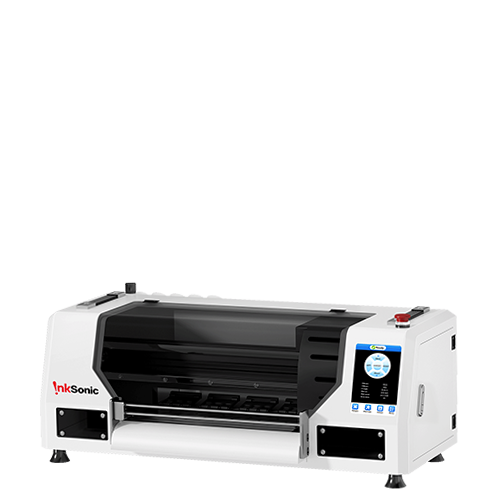
DTF print, or direct-to-film printing, is a film-based transfer process. The design is not printed directly onto the garment. Instead, it is printed onto a special PET film using water-based pigment inks. After printing, adhesive powder is applied to the design and cured with heat. The image is then transferred onto fabric with a heat press.
Once applied, the design bonds with the fabric surface. Color performance stays stable, and the process works across cotton, polyester, and blended fabrics. Because the entire workflow is built around film printing and heat transfer, DTF printing is often chosen for jobs that need consistent results and repeatable output.

Laser for T-Shirts vs DTF Printing: Which Is Better?
The real difference between laser-based T-shirt methods and DTF printing is not only what each system can produce. It is how they behave when the same job is repeated again and again.
Stability Under Repeated Production
Laser for T-shirts can give acceptable results for one-off or low-volume jobs. But the output is sensitive to small changes. Transfer paper quality, heat press temperature and pressure, alignment, and even fabric prep can create slight shifts when the same design is rerun.
DTF printing is more controlled. Once the film is printed, powdered, cured, and transferred correctly, the result tends to stay consistent across multiple runs—even as volume increases.
Level of Manual Dependency
Laser for T-shirt workflows has more hand-touch points. Design prep, transfer alignment, pressing time, and material handling all need operator attention, and small changes at any step can change the final look.
DTF printing trims many of those touchpoints. After the design is prepared and printed, the transfer stage is more straightforward, so the overall workflow is less tied to constant manual adjustment.
Scalability in Production
Lasers for T-shirts are usually a better fit for small batches, custom pieces, or occasional production. When order volume rises—or when every job needs a new setup—the workflow can slow down quickly.
DTF printing fits more naturally into continuous production. It handles repeated orders, mixed designs, and longer runs with fewer interruptions, which makes it more practical for higher-volume or ongoing work.
Fabric and Application Range
Laser transfer methods usually perform best under simpler or more controlled fabric conditions, where heat transfer behavior and surface compatibility are easier to predict.
DTF printing covers more ground. Dark garments, mixed textiles, and a wider range of fabric types are easier to handle while keeping adhesion and color performance reasonably stable.
Production Behavior in Practice
Over time, these differences become hard to miss. Laser-based workflows often need more frequent adjustments depending on materials, setup, and daily conditions. DTF printing, when the process is kept consistent, usually settles into a more stable output pattern.
| Factor | Laser |
DTF |
|
Consistency |
Moderate |
High |
| Manual Work |
Higher |
Lower |
| Scalability |
Small batches |
High volume |
|
Fabric Range |
Limited |
Wide |
|
Workflow Stability |
More adjustments | More consistent |
|
Best For |
Hobby/custom work | Business production |
Conclusion
When comparing laser-based T-shirt methods and DTF printing, the main gap is not raw capability. It is how each process fits into a specific production workflow.
Laser-based methods tend to suit situations where flexibility and smaller runs matter more. Custom work, experimental projects, and jobs that need manual tweaking are a natural match. The extra hands-on steps are not always a weakness; they allow room for variation.
DTF printing is usually the stronger choice when repeatability and steady production flow matter more. Ongoing orders, repeated designs, and structured shop setups benefit from the lower variation between batches.
In practice, these are not always competing systems. They are different tools for different conditions. The better question is not “Which one is superior?” but which one matches your production structure over time.


