


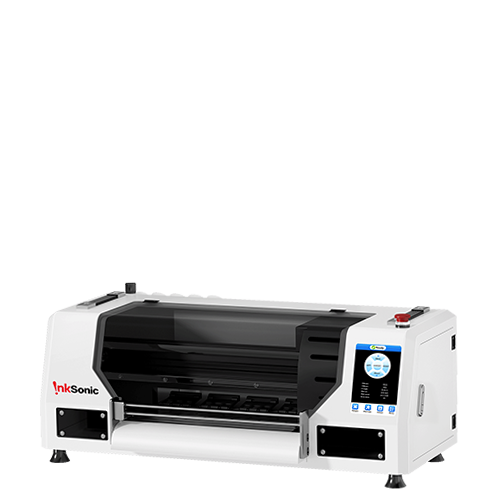


If you've spent any time shopping for a DTF printer, you already know the printhead is where the real decision happens. Sure, the printer body counts for something. But the printhead will decide how fast your prints will be, how accurate the colors will be, how often you will need to unclog and finally your costs per print.
There are currently three printheads on top of the DTF world in 2026 – the Epson XP600, the Epson i1600, and the Epson i3200. All of them have their place in the market and none of them are bad – they simply serve different businesses at different stages of development.
This guide breaks down what each one genuinely does well, so you can match the right printhead to where your business actually is right now.

Quick Comparison: XP600 vs i1600 vs i3200
Before diving in, here's a snapshot of where each printhead sits:
Feature |
XP600 |
i1600 |
i3200 |
Technology |
Micro-Piezo |
PrecisionCore MEMS |
PrecisionCore MicroTFP |
Nozzle Count |
1,080 |
1,600 |
3,200 |
Resolution |
1,440 dpi (interpolated) |
600 dpi (native) |
600 dpi (native) |
Print Speed |
About 10–16㎡/h |
About 18–25㎡/h |
About 25–35㎡/h |
Price |
$ 400+ |
$ 800+ |
$ 1200+ |
Production Level |
Entry-level |
Mid-volume |
High-volume |
Best Match |
New businesses and smaller print shops |
Shops ready to scale output |
Commercial production and larger daily runs |
The numbers give you a starting point, not the whole picture. What actually separates these three heads is how they fit different production realities — and that's what the sections below get into.
XP600: A Strong Starting Point for Smaller DTF Operations
The XP600 has stayed relevant because it solves a very practical problem. It gives smaller shops a way to enter DTF printing without taking on a larger investment too early.
That matters more than raw specs suggest. For a new business, the biggest challenge usually is not squeezing out maximum throughput on day one. It is getting a reliable setup in place, learning the workflow, and keeping costs manageable while orders are still growing. The XP600 fits that stage well because machines built around it are generally easier to buy into, and replacement costs are less intimidating than what comes with higher-tier heads.
It also benefits from being widely used. Parts are easier to source, ink compatibility is broad, and support information is easy to find. That kind of ecosystem makes ownership less stressful, especially for shops that are still learning how to keep a DTF workflow running smoothly from week to week.
On the production side, the XP600 is well suited to standard apparel work, short runs, custom orders, and designs built around bold graphics, logos, and everyday commercial output. It is not positioned as a high-volume printhead, and that is exactly why it makes sense for entry-level production. Its value is not in being the fastest option. Its value is in being accessible, proven, and realistic for businesses that need a dependable starting point.
i1600: The Best Upgrade When Production Starts to Tighten
The i1600 makes the strongest case when a shop has already moved beyond the earliest stage and starts feeling pressure from volume.
This is often the point where a business is no longer asking whether DTF will work. The model is already working. Orders are becoming consistent, turnaround times matter more, and the real issue is whether the current setup can keep up without stretching the workday too far. That is where the i1600 starts to make sense.
Compared with the XP600, the i1600 offers a clear increase in nozzle count and is better positioned for mid-volume output. It is the kind of upgrade that helps a shop produce more without jumping straight into a fully commercial production environment. For many operators, that middle ground is exactly where the buying decision gets serious.
Another reason the i1600 stands out is balance. It gives a business more production capability, but it does not push the operation into a level of investment that only makes sense under constant heavy load. In other words, it supports growth without forcing the business to grow unnaturally fast just to justify the machine.
In day-to-day use, the i1600 works well for shops that are producing regularly, managing repeat work, and looking for a setup that feels more scalable than entry-level hardware. It is often the printhead that makes the most sense when efficiency becomes the next priority.
i3200: The Right Choice When Output Becomes the Business
The i3200 belongs in a different conversation because it is built for operations where production volume already drives decision-making.
Its biggest advantage is straightforward: much higher nozzle count and much stronger throughput potential. With 3,200 nozzles and the more advanced PrecisionCore MicroTFP platform, the i3200 is designed to handle heavier daily workloads with less strain on the production schedule. When a shop is printing at a level where time directly affects margin, capacity, and client turnaround, that advantage becomes very real.
There is also a quality argument for the i3200. It is a strong fit for shops producing more demanding graphics, smoother tonal transitions, or work where finish and detail influence how the customer perceives value. In those cases, the i3200 is not simply about going faster. It also supports a more premium output standard.
What separates the i3200 from the other two is not just that it is more advanced. It is that its strengths only become fully valuable when a business is ready to use them. For wholesale production, larger daily runs, contract printing, or commercial DTF shops with steady volume, the i3200 can open up more room for growth. For lighter workloads, much of that capability may go unused.
That is why the i3200 is best seen as a production tool first. Once a shop reaches the point where output capacity affects revenue, it becomes a very logical investment
Which Printhead Makes the Most Sense
The easiest way to choose between these three is to be honest about the stage your shop is actually in.
The XP600 is the practical choice for smaller operations, newer businesses, and buyers who want a lower-risk entry point. Its appeal comes from affordability, broad support, and a setup that is easier to live with while the business is still building momentum.
The i1600 makes the most sense for growing shops that have already proven demand and now need more output without making a large leap into full commercial production. It fills the gap between affordability and stronger capacity better than almost any other option in this category.
The i3200 is the right fit when speed, production volume, and workflow efficiency are no longer nice extras but core business requirements. It is best suited to shops that already have enough order flow to benefit from a more advanced head on a daily basis.
One point matters across all three: a printhead does not perform in isolation. RIP software, ink quality, film, maintenance habits, and curing all shape the final result. A well-matched system usually matters more than picking the most advanced printhead available.
Final Thoughts
The XP600, i1600, and i3200 each represent a different stage of running a DTF business. A lot of serious operators have used all three at different points, not because they made the wrong call early on, but because their operation grew and their tools grew with it.
Start where your current volume justifies. Upgrade when the throughput ceiling becomes the actual constraint. And don't let comparison charts push you into hardware you haven't earned the volume to support yet.
The right printhead is the one that fits the business you have today, with enough room to grow into the one you're building toward.


